Guided Walking Tours in Portugal (2026): A Deeper Way to Experience the Country
Written by Sérgio Marques, Founder & Route Designer, Top Walking Tours Portugal
May 29, 2026
1225 words
6 minutes
Walking through Portugal is already one of the most immersive ways to explore the country, but doing it with a guide changes the experience entirely.
Instead of simply following a path from one place to another, you begin to understand what you are seeing. Villages gain context, landscapes start to tell their own story, and the journey becomes something richer than just a physical activity.
Guided walking tours in Portugal are designed exactly for that: not only to take you through beautiful routes, but to connect you with the culture, the history, and the rhythm of the places you cross.
If you are considering this style of travel, it’s worth starting with a broader understanding of how these experiences are structured in this complete guide to walking tours in Portugal.
At the same time, many travellers hesitate between going independently or choosing a guided experience, this detailed comparison between self-guided vs guided walking tours can help clarify what suits your travel style best.
What defines a guided walking tour in Portugal
A guided walking tour is a multi-day experience where everything is organised in advance, and a professional guide accompanies you throughout the journey.
This means that, from the moment the tour begins, the structure is already in place: your accommodation is booked, your luggage is transferred between hotels, the routes are planned, and your daily experience is supported on the ground.
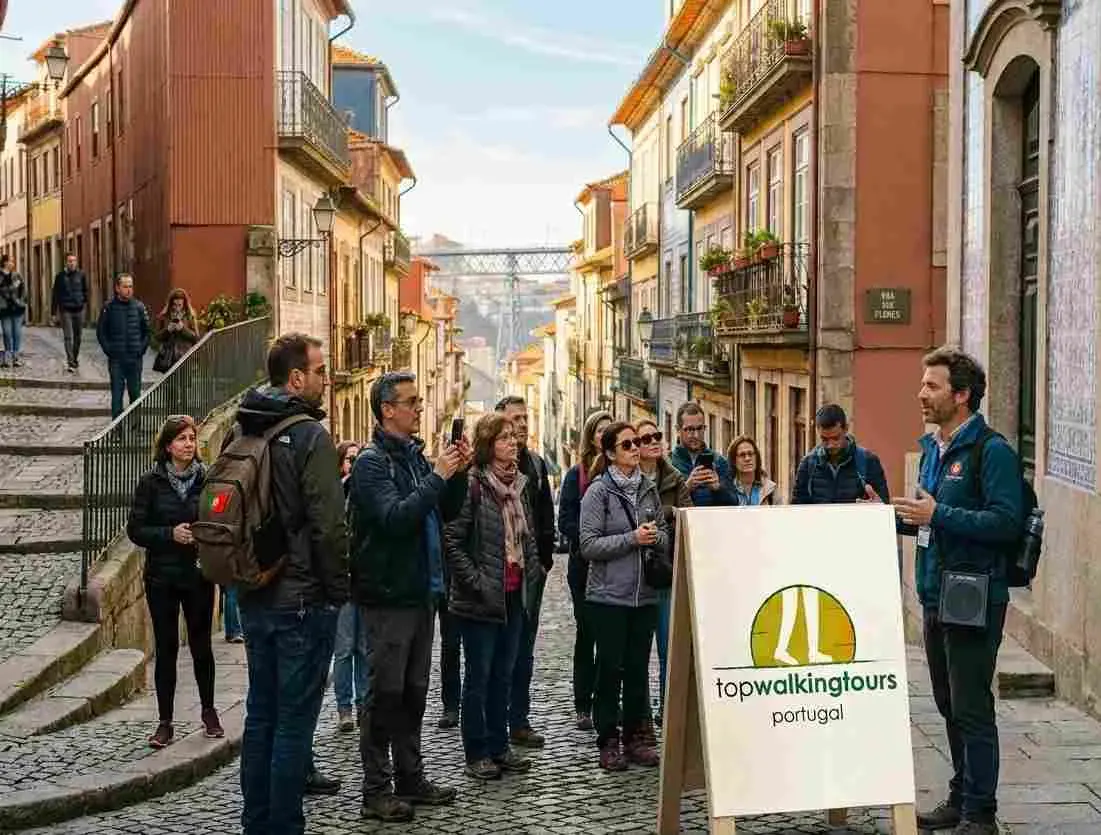
On top of what you would expect from a self-organised trip, guided tours include an additional layer of support and interpretation. In practice, this translates into having someone who not only shows you the way but also explains it, whether that’s the story of a medieval village, the origin of a vineyard landscape, or the meaning behind a traditional dish.
If you want to see how these experiences are typically organised, you can explore our tours.
What is actually included (and why it matters)
One of the biggest misunderstandings travelers have is assuming that guided tours are simply “self-guided tours with a guide”. In reality, they are much more structured.
A guided walking tour in Portugal includes all the core logistics like accommodation, breakfast, luggage transfers, route design and transfers. But adds several key elements that fundamentally change the experience.
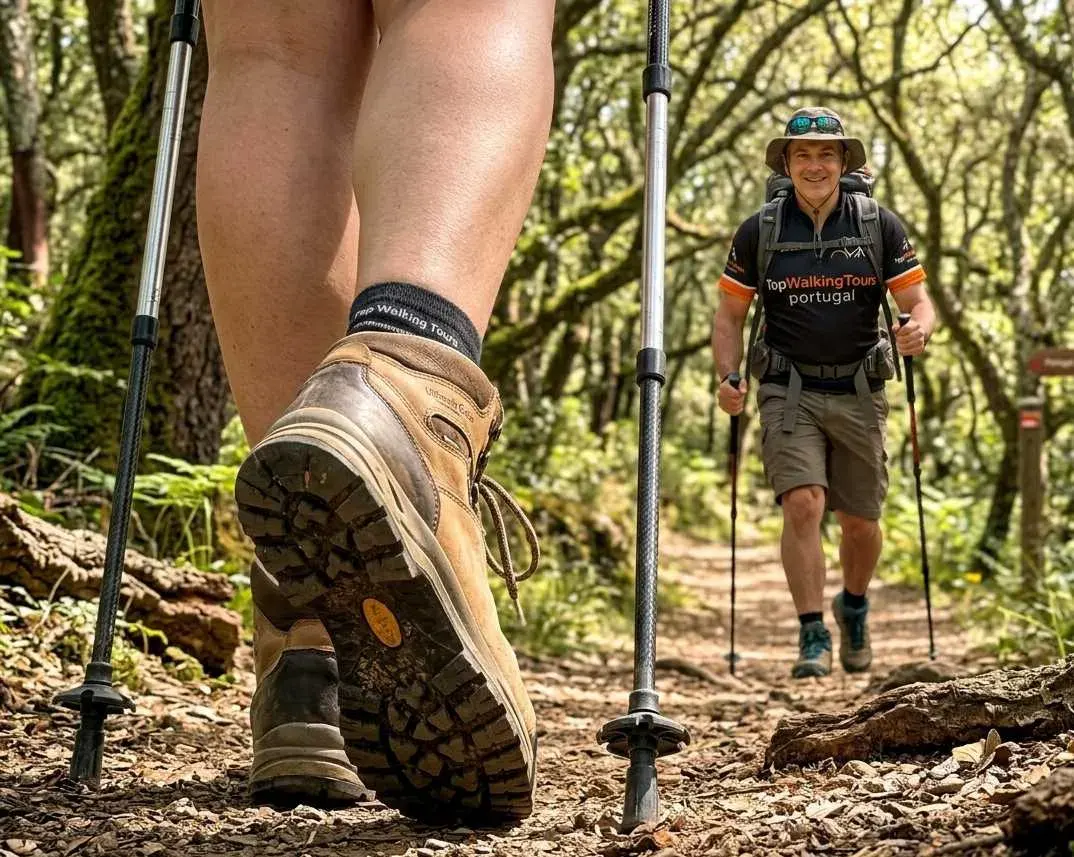
You are accompanied by a professional guide throughout the journey, and there is typically a support vehicle available during the route. This means that you are never fully on your own: if you feel tired, encounter bad weather, or simply want to shorten a stage, there is always assistance available.
In addition, guided tours often include water, snacks, and organised group meals, creating a rhythm that alternates between walking, resting, and sharing moments with others.
This structure removes almost all logistical friction. You don’t need to think about where your luggage is, whether you are on the correct path, or how long the next stage will take. Instead, you focus on walking and on everything happening around you.
The real value: beyond convenience
It’s easy to assume that the main advantage of a guided tour is convenience. While that is certainly true, it’s not the most important part.
The real difference lies in understanding and connection.
Portugal is a country where the details matter. A small village in the Alentejo, for example, can look simple at first glance, but behind it there is a history of migration, agriculture, and cultural identity that you would likely miss without context. The same applies to the Douro Valley, where landscapes shaped by vineyards only fully make sense when someone explains how they were built over centuries.
On a guided tour, you are not just passing through places, you are interpreting them.
At the same time, the presence of a guide changes the pace of the journey. Rather than constantly checking maps or GPS, you are free to look around, to stop naturally, and to experience the landscape more fully. According to the structure described in your own tours, guided experiences are designed with a maintained pace that prioritizes both enjoyment and comfort.
Support and flexibility on the trail
One of the aspects many travelers underestimate is how valuable on-the-ground support becomes over several days of walking.
Even on relatively easy routes, fatigue accumulates. Weather changes. Small issues appear, from blisters to unexpected terrain conditions. Having a guide and a support vehicle nearby transforms how these situations are handled.
Instead of becoming problems, they become adjustments. You can shorten a stage, pause when needed, or simply enjoy the reassurance that help is available if necessary.
This is particularly important on longer routes or linear itineraries, where logistics can be more complex.
A social way of travelling
Another dimension that often defines guided walking tours is the social experience.
Unlike self-guided travel, where the journey is more private, guided tours typically bring together small groups of travellers with a shared interest. Over the course of several days, walking, eating, and experiencing the same landscapes naturally creates connections.
For some travellers, this is a major advantage. For others, it’s simply a subtle bonus like a conversation at dinner, a shared moment at a viewpoint, or the collective rhythm of walking together.
Where guided tours make the most sense
While guided walking tours can be done anywhere in Portugal, there are certain routes where they tend to offer a particularly strong advantage.
The Camino de Santiago, for example, is not just a physical route but a cultural and historical journey. Walking it with a guide adds a layer of meaning that goes far beyond navigation.
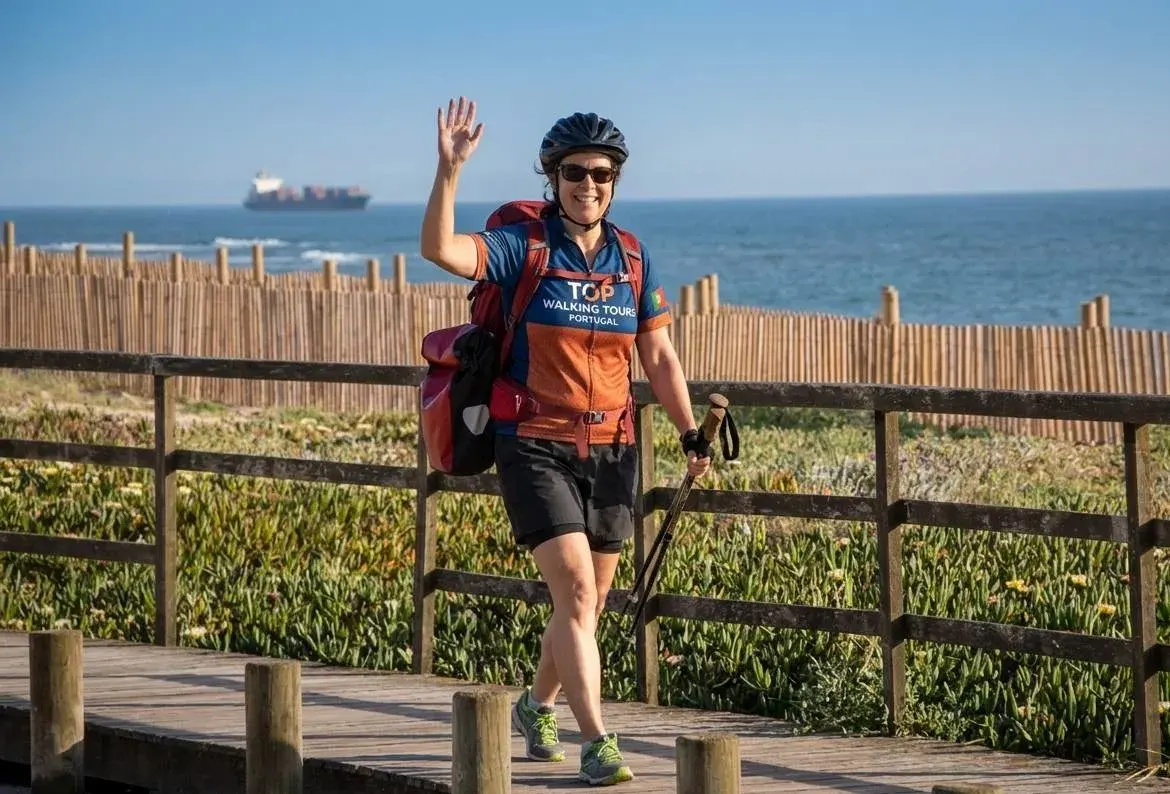
Coastal routes, especially along the Atlantic ** ** or Vicentine Coast, also benefit from guided logistics. These are often linear trails, where coordination between start and end points can be complex. Having that organised, along with support along the way, makes a noticeable difference.
In regions like the Douro Valley, the value is more interpretive. These are landscapes where local knowledge transforms the experience, whether through wine culture, rural traditions, or hidden places that are not immediately obvious.
How this compares to independent walking
For travellers deciding between options, it’s important to understand that guided tours are not necessarily better, but they are different.
If you compare them directly with independent travel, the contrast is clear. Self-guided walking emphasises freedom and flexibility, while guided tours emphasise structure, depth, and support.
If you want to understand that comparison in detail, you can read.
When a guided tour is the right choice
Guided walking tours tend to be the best fit when the goal is not just to walk, but to fully experience a destination.
They are particularly well suited for travellers who prefer not to manage logistics, who value cultural understanding, or who feel more comfortable having support available throughout the journey.
They also make a lot of sense for first-time visitors to Portugal, or for longer, multi-day routes where organisation becomes more complex.
A more complete way to walk Portugal
At its core, a guided walking tour is not just about making things easier. It is about making the experience richer.
Portugal rewards slow travel. It rewards attention. And when someone is there to guide that perspective, to explain, to interpret, and to support the journey becomes something more than just a series of walks.
It becomes a deeper way of understanding the country.